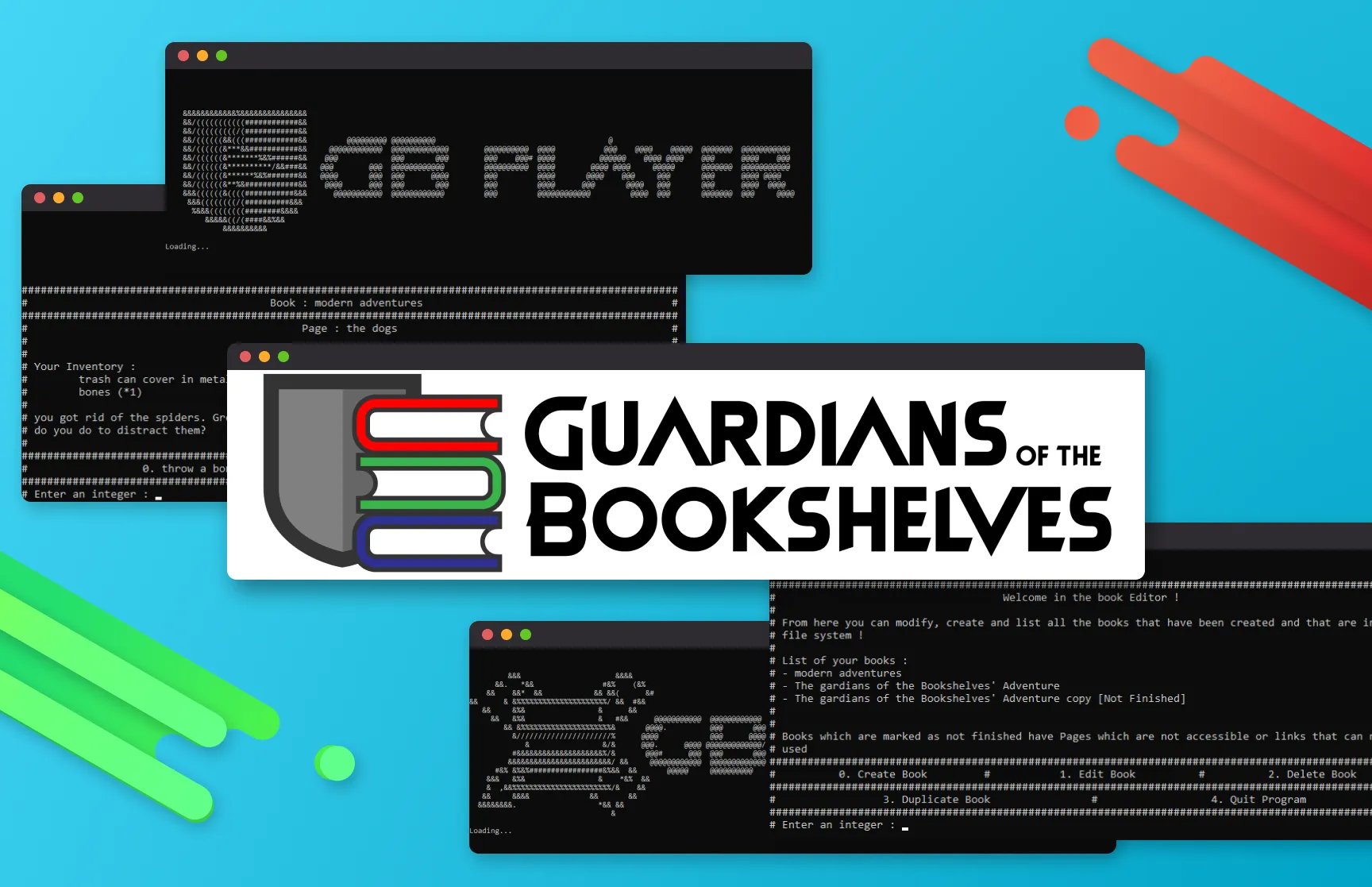
Guardians of the bookshelves
Guardians of the bookshelves is a game book editor in the terminal. GB also offers you to play the books you create! A class project in groups of 4 over 2 months
- Git
- python
Project Overview
Guardians of the Bookshelves is a terminal-based interactive fiction engine that allows users to both create and play “choose your own adventure” style game books. Developed as a group project with 4 team members over 2 months.
What is a Game Book?
Game books (also known as interactive fiction or CYOA books) are stories where readers make choices that affect the narrative. At key points, the reader chooses between options like:
You enter the dark cave. Do you:
- Light a torch and proceed (go to page 15)
- Wait for your eyes to adjust (go to page 23)
- Turn back (go to page 7)
Features
Book Editor
The editor allows authors to create complete game books:
- Create pages with narrative text
- Add choices that link to other pages
- Set conditions for choice availability (items, flags, stats)
- Add inventory items that players can collect
- Define endings (win, lose, or neutral)
- Preview and test books during creation
Book Player
The player provides an immersive reading experience:
- Display narrative with proper formatting
- Present choices and handle player input
- Track inventory and game state
- Save/load progress at any point
- Multiple book support with a library system
Book Format
Books are stored in a custom JSON-based format:
{
  "title": "The Lost Temple",
  "pages": {
    "1": {
      "text": "You stand before an ancient temple...",
      "choices": [
        {"text": "Enter the temple", "goto": 2},
        {"text": "Search the perimeter", "goto": 5}
      ]
    }
  }
}
Technical Implementation
Architecture
The project follows a modular design:
- Core engine: Handles game logic and state
- Editor module: CLI interface for book creation
- Player module: CLI interface for playing books
- Storage layer: File I/O for books and saves
Team Collaboration
Working in a team of 4, we used:
- Git for version control with a branching strategy
- Task distribution based on modules
- Code reviews before merging
- Regular sync meetings to coordinate
Challenges
- State management: Tracking complex game states with conditions and inventory
- User experience: Making a terminal interface intuitive and enjoyable
- Data validation: Ensuring books are valid and playable before saving
- Team coordination: Integrating work from 4 developers smoothly
What I Learned
- Team collaboration on a shared codebase
- Git workflows in a multi-developer environment
- Modular design for maintainable code
- User-centered design even in CLI applications
- Documentation to help teammates understand code