Midgard
Score-based competitive markets on Starknet. Factory Owners stake on game scores, Challengers pay to beat them, Vault Investors provide capital. Built by RuneLabs.
- SvelteKit
- Svelte 5
- TypeScript
- PostgreSQL
- Drizzle
- Starknet
- Cairo
- Dojo
- TailwindCSS
- Blender
- Three.js
- Threlte
Overview
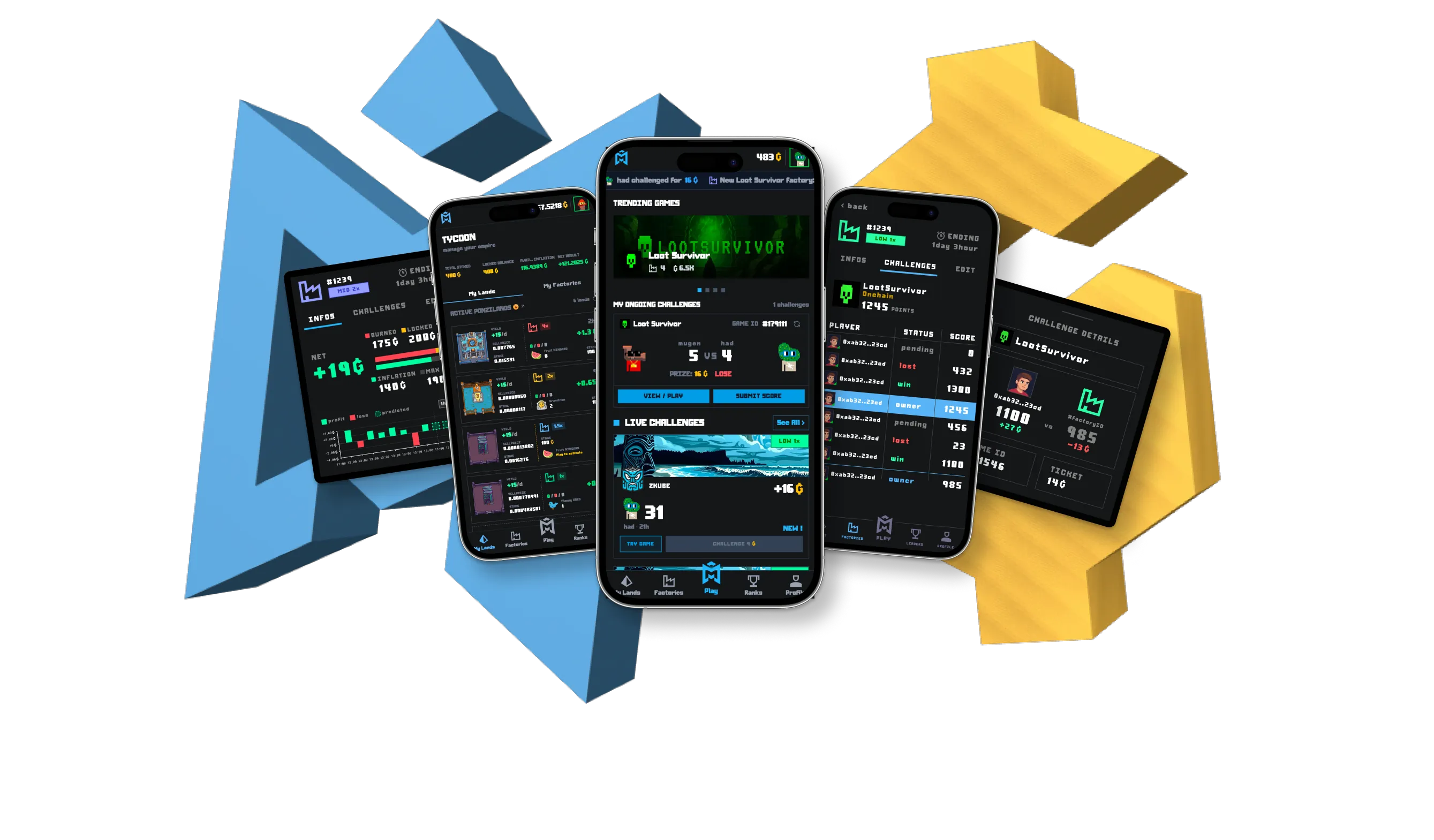
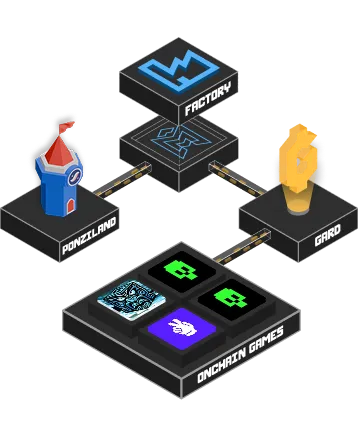
Midgard turns game scores into competitive markets. Factory Owners select a game, set a score target, and stake capital. Challengers buy ticket attempts to beat the score: losses feed the factory, wins pay out to the challenger. Vault Investors supply capital and earn lending returns. Seasonal prize pools reward top performers.
Live at midgard.game, docs at docs.midgard.game, beta at beta.midgard.game. Built by RuneLabs (same team as PonziLand).
My Role
Full-stack dev plus art direction across code, 3D, and brand:
- Frontend: SvelteKit 5 app, Svelte 5 runes, TailwindCSS
- Backend: Server routes, game session logic, API endpoints
- Database: PostgreSQL schema with Drizzle ORM
- Onchain: Cairo contracts on Starknet via Dojo for factories, stakes, and vault accounting
- Indexing: Torii + custom indexers to stream onchain state into the app
- 3D / Visual: Blender assets (factory, parcels, props), Three.js integration in-app, brand + logo design
Technical Challenges
Three-role Economy
Balancing Factory Owners, Challengers, and Vault Investors so every role has positive expected value in some market condition. Stake sizing, ticket pricing, and vault yield all interact; onchain math has to stay consistent with UI-visible odds.
Score Verification
Scores come from mini-games played in-app. Preventing score forgery while keeping the UX snappy required signed session proofs and server-side replay checks before any onchain settlement.
Svelte 5 Runes at Scale
Migrating from Svelte 4 stores to $state / $derived / $effect. Reactivity is more explicit but needs discipline to avoid cross-component effect storms.
Onchain ↔ Offchain Sync
Factories, stakes, and vault positions live onchain; game sessions and matchmaking live offchain. Event-driven sync via Torii keeps both sides consistent; reorg handling and timeout expiry are the hard edges.
Visual Identity
Logo Design
The Midgard wordmark pairs a chunky, slightly-beveled sans with a stylized “M” glyph echoing a factory silhouette: two stacks, a tapered roofline. Goal: read as industrial / mercantile without falling into crypto-tech clichés (no gradients, no circuit lines). Flat fills, high contrast, one accent color so the mark survives on busy game backdrops and small favicon sizes alike.
Header & Banners
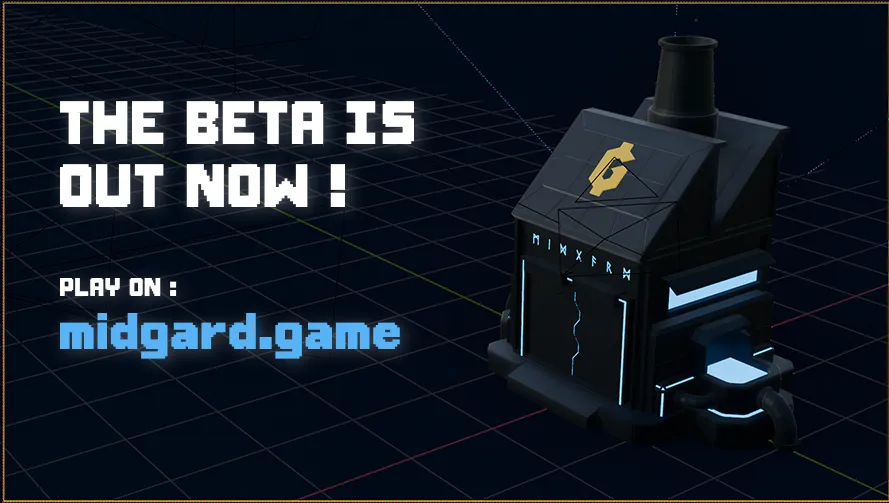
The header art uses the isometric factory as the anchor, with the wordmark locked to a consistent baseline. Beta banner variants reuse the same factory render so cross-surface recognition stays tight.
3D Assets in Blender
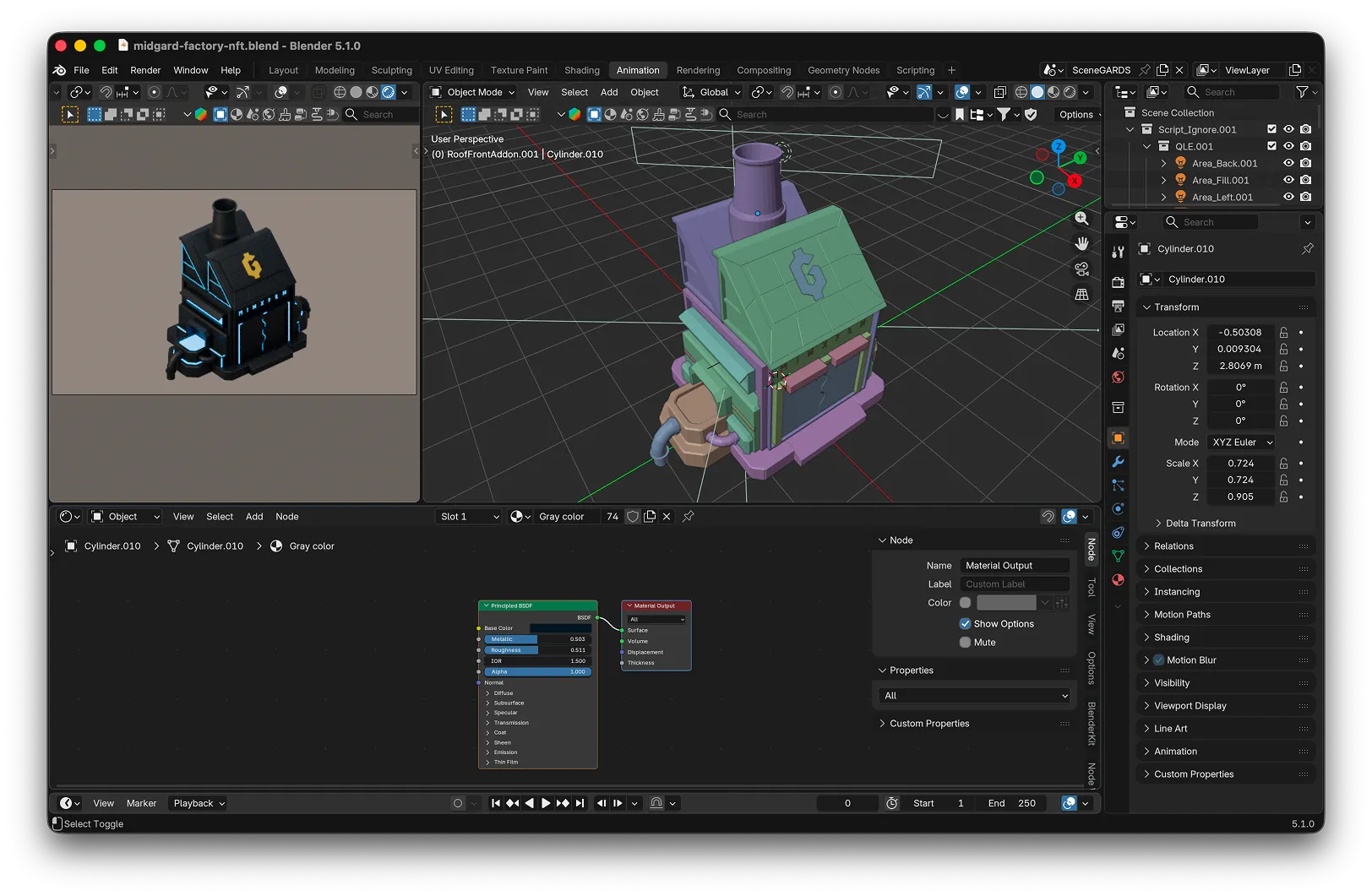
Every hero visual on the site and in-app comes from a single Blender scene. One source of truth means silhouettes, materials, and lighting stay consistent across the landing page, app banners, marketing, and in-world 3D.
- Factory model: Low-to-mid-poly industrial block, custom PBR materials, baked ambient occlusion for the isometric hero renders
- Isometric renders: Orthographic camera at a fixed 30°/45° rig, matching the game grid so 2D marketing art and 3D in-app view share the same angle
- GLTF export: Same meshes feed the web runtime (Draco-compressed, KTX2 textures) so what ships in Three.js matches the marketing renders pixel-for-vibe
- Blender Cycles settings: Low-sample denoised renders for iteration, higher-sample passes for hero frames (see my Blender render checklist post)
Three.js Integration
The in-app 3D view is built on Three.js via Threlte (Svelte bindings for Three.js), so 3D components compose like any other Svelte 5 component and share the same $state/$derived reactivity.
Pipeline:
- Blender → GLTF (Draco mesh compression, KTX2 textures) → hosted as static assets
<GLTF>loader in Threlte, instanced meshes for repeated parcels/props- Orthographic camera matched to the Blender render angle so 3D view ↔ marketing art never feel disjoint
- Post-processing: mild bloom on factory emission, SSAO for grounding, tonemapping tuned to match the Blender output
- Budget: one 3D canvas per scene, lazy-loaded on route, targeting 60fps on mid-tier laptops and ~30fps on mobile
Why Three.js over a pre-rendered image loop: factories need to reflect live onchain state (stakes, tenants, score trends). Live 3D ties visual feedback directly to the game economy instead of faking it with sprite swaps.
Key Features
- Factories: Score competitions staked by Factory Owners
- Ticket challenges: Pay-to-attempt, winner-takes-stake mechanic
- Vaults: Capital pools earning yield from factory flow
- Seasonal prize pools: Performance-based rewards each season
- Starknet wallet: Cartridge Controller integration for gasless sessions
- Dashboard: Factory stats, leaderboards, vault positions
What I Learned
- Designing a three-sided market that stays fun and solvent
- Shipping Cairo/Dojo contracts alongside a SvelteKit 5 app
- Anti-cheat patterns for score-based onchain games
- Operating a beta with real stakes and real users
- Owning a full visual pipeline (Blender source → GLTF → Three.js runtime → marketing renders) from a single scene